ServiceNow · REST APIs · TypeScript · OAuth · PostgreSQL · AI-assisted ITSM
Automating incident management sounds straightforward: read a ticket, decide what needs to happen, and update the record. In practice, the difficult part isn’t making an API request. It’s deciding when a change is justified, enforcing the right constraints, and leaving an audit trail that another technician can understand.
That was the motivation behind OpsPilot, my development-stage experiment in safer, AI-assisted ServiceNow incident operations. This article walks through the design, the tests that worked, an OAuth problem I couldn’t immediately solve, and what I learned along the way.
Start with the failure modes
After years working in enterprise IT support, I know that a ticket update can have consequences beyond the immediate record. A wrong assignment can delay resolution. An incorrect state change can hide unresolved work. An automated system that cannot explain its decisions creates more problems than it solves.
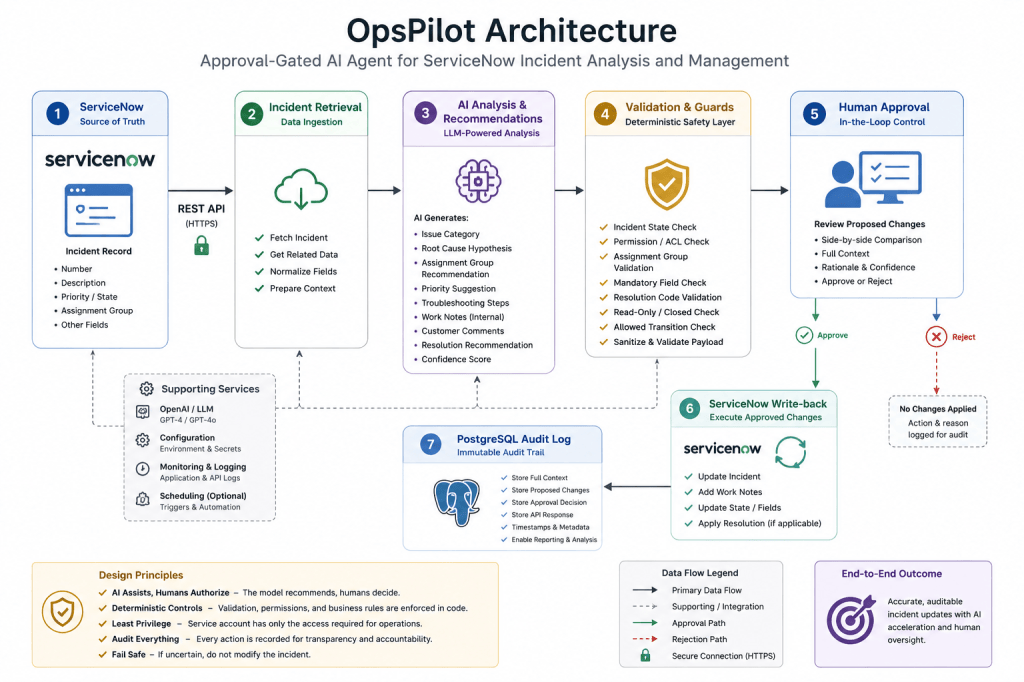
I therefore designed OpsPilot around a simple rule: recommendations and write permissions should be separate decisions. The system can analyze an incident and suggest a next step, but a proposed action still needs to pass explicit checks before any record is changed.
The architecture: read, reason, validate, act, record
The intended workflow is retrieve incident → analyze evidence → propose an action → validate safeguards → apply a permitted update → record the outcome.
- ServiceNow REST APIs provide the incident retrieval and update surface.
- TypeScript handles application logic and validation.
- PostgreSQL on Neon provides the foundation for recording decisions and audit evidence.
- Human review remains part of the design for consequential recommendations.
The prototype also includes an AI-assisted triage interface using a synthetic account-lockout scenario. It presents a proposed priority, clarifying questions, likely causes, a troubleshooting path, and an editable customer response. That demonstration is not evidence of a live ServiceNow connection: the interface explicitly indicated that ServiceNow was unavailable during the captured session.
Guardrails before automation
One of the first safeguards was preventing modifications to closed incidents. That’s a small rule with an important purpose: the existence of an API endpoint does not mean every technically possible update should be allowed.
For higher-impact changes, I want the system to retain the proposed action, the relevant incident state, the validation result, and the final outcome. That separation makes it easier to investigate unexpected behavior and keeps the human operator accountable for approval.
What worked in the ServiceNow developer instance
I tested controlled updates against a sample incident in a ServiceNow personal developer instance. The workflow successfully reassigned the incident to a hardware support group. I then tested resolving the incident after supplying the required resolution information.
These tests established that controlled incident updates were possible in that environment. They do not establish production readiness, broad reliability, customer adoption, or measured time savings. Those would require additional testing and operational evidence.
The OAuth client-credentials roadblock
A later integration attempt ran into a more interesting challenge. I created an OAuth client in a second ServiceNow developer instance and attempted to request a token using the client-credentials grant. The token endpoint returned an access_denied error, surfaced as a server error response.
I checked the inbound client-credentials grant configuration, including the relevant ServiceNow property, but the test remained unresolved. I didn’t treat that failure as proof that the integration was complete, nor did I bypass the authentication problem with an unsafe workaround.
The lesson was practical: integration design has to include identity, grant configuration, permissions, and failure handling—not just the happy-path HTTP request. A successful API call in one environment doesn’t guarantee that a different authentication flow is configured correctly in another.
What I’d test next
- Validate a supported authentication method and document its required permissions.
- Expand test coverage across incident states, including rejected updates and already-closed records.
- Confirm that each allowed and denied action generates useful audit evidence.
- Exercise human approval and rejection paths with realistic synthetic tickets.
- Measure reliability and operational impact before making any production-performance claims.
The bigger lesson
OpsPilot reinforced something I’ve learned from enterprise support: the best automation doesn’t remove judgment—it makes routine work more consistent while preserving visibility into consequential decisions.
Building the prototype pushed me deeper into REST integration, ServiceNow incident lifecycles, TypeScript, database-backed auditing, and authentication troubleshooting. Just as importantly, it reminded me to document what didn’t work. Those constraints are often where the most useful engineering lessons live.
Read the OpsPilot case study · Explore the project on GitHub


Leave a Reply