AI-Powered IT Troubleshooting Agent
Building smarter IT diagnostics through AI-powered automation.
AI-assisted IT support · Python · OpenAI API · Streamlit · Evaluation
The challenge
Repetitive technical incidents can consume significant support time, while incomplete diagnostic notes make escalations harder. Drawing on enterprise IT support experience, I explored whether a structured AI agent could reduce unnecessary troubleshooting steps while preserving correct decisions and evidence.
What I built
SuperR is an AI-assisted Tier 1 diagnostic prototype. It interprets simulated incidents, selects diagnostic actions, determines whether to resolve or escalate, and generates structured supporting information for handoff.
How it works
Built with Python, the OpenAI API, and a Streamlit interface, the prototype combines a controlled diagnostic workflow with repeatable evaluation scenarios. Each run can be compared against expected incident outcomes and a deterministic baseline.
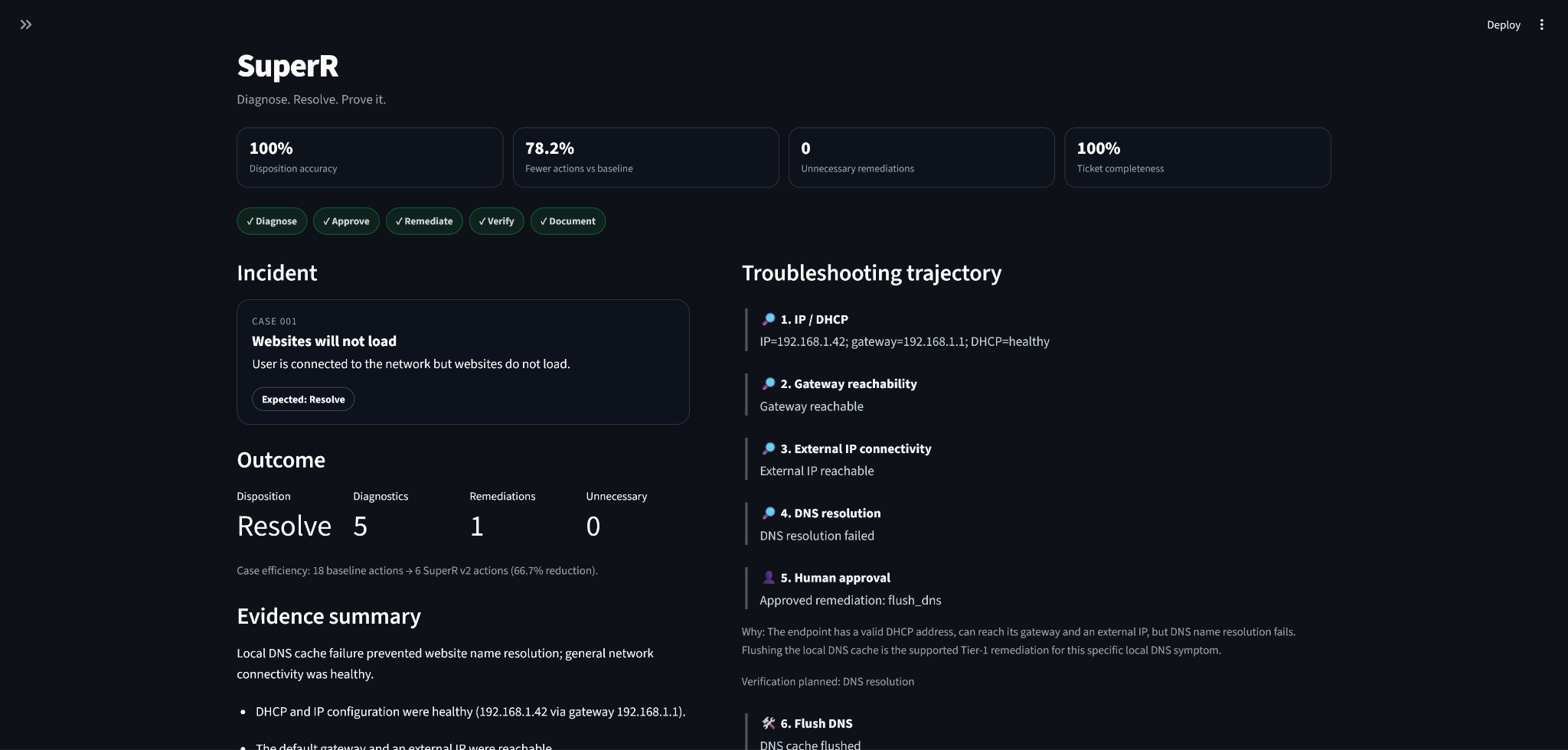
Inside SuperR: a simulated DNS incident
This demonstration follows a simulated case in which a user can connect to the network but websites fail to load. SuperR narrows the issue to DNS resolution, requests human approval for a cache flush, verifies the result, and documents the outcome.
Workflow architecture
Incident input → Diagnostic checks → Evidence-based diagnosis → Human approval → Remediation → Verification → Structured incident record.
This is a conceptual view of the demonstrated workflow, not a production infrastructure diagram. A technician remains in control of approved remediation.
Verified outcome and documentation
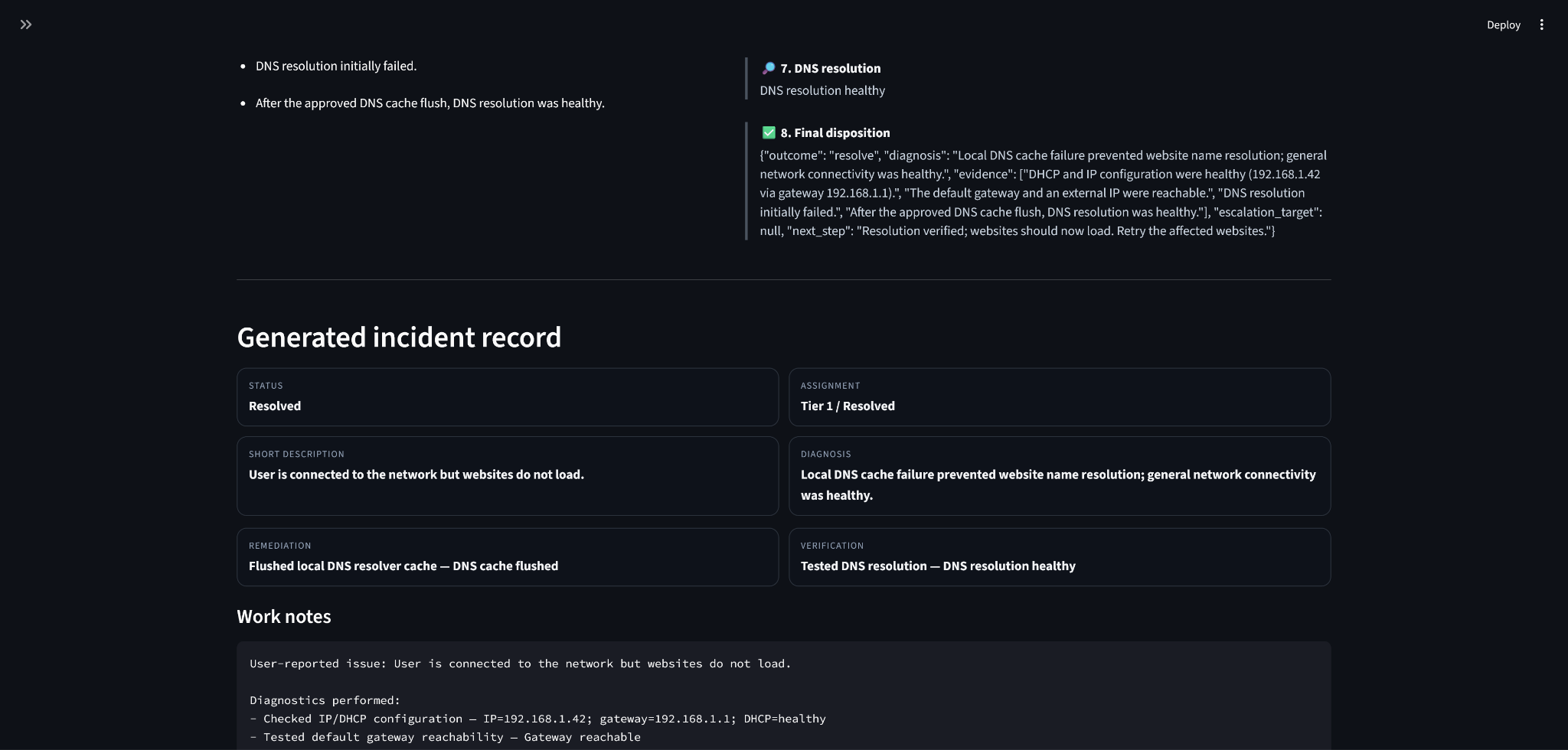
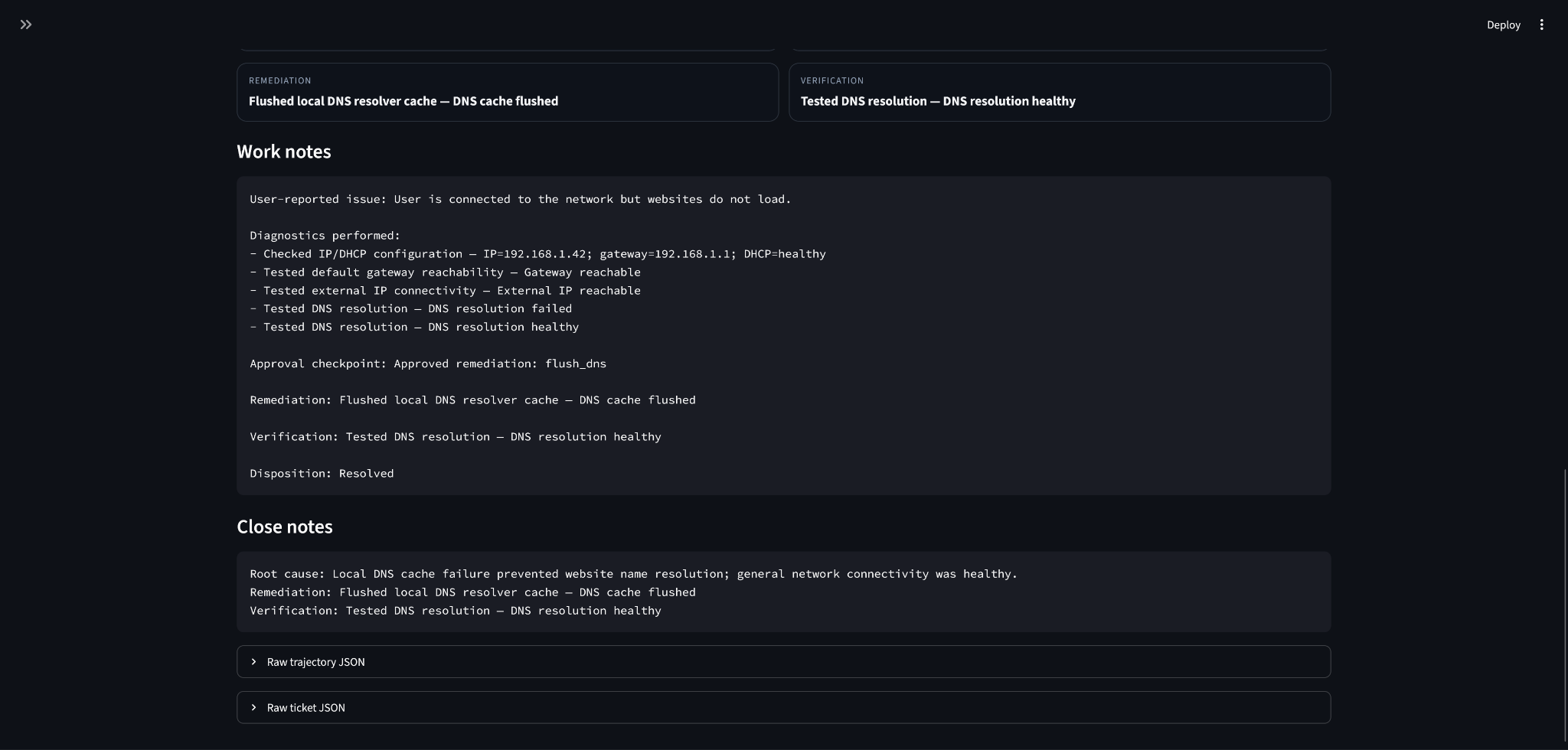
Demonstration uses simulated incident data. The single-case action reduction shown in the interface is not a production performance claim.
Measured results
| Evaluation | Baseline mean actions | SuperR mean actions | Reduction |
|---|---|---|---|
| Development set (12 simulated cases) | 18.00 | 3.92 | 78.2% |
| Holdout set (5 simulated cases) | 18.00 | 3.00 | 83.3% |
SuperR produced correct resolve-or-escalate outcomes on the evaluated cases. These are small, controlled simulations, not production benchmarks; the five-case holdout is too limited to establish real-world reliability.
Engineering decisions
I focused on reducing diagnostic actions without treating speed as a substitute for correctness. The evaluation approach checks both the action count and the final disposition, while structured escalation output preserves evidence for a human technician.
What I learned
This project strengthened my skills in AI agent workflows, Python development, evaluation design, and translating operational knowledge into testable software. It also reinforced the need for clear safeguards, broader test coverage, and human oversight before real-world deployment.
Next steps
Expand incident scenarios and holdout coverage, test more realistic diagnostic environments, and explore integrations with IT service management workflows.

